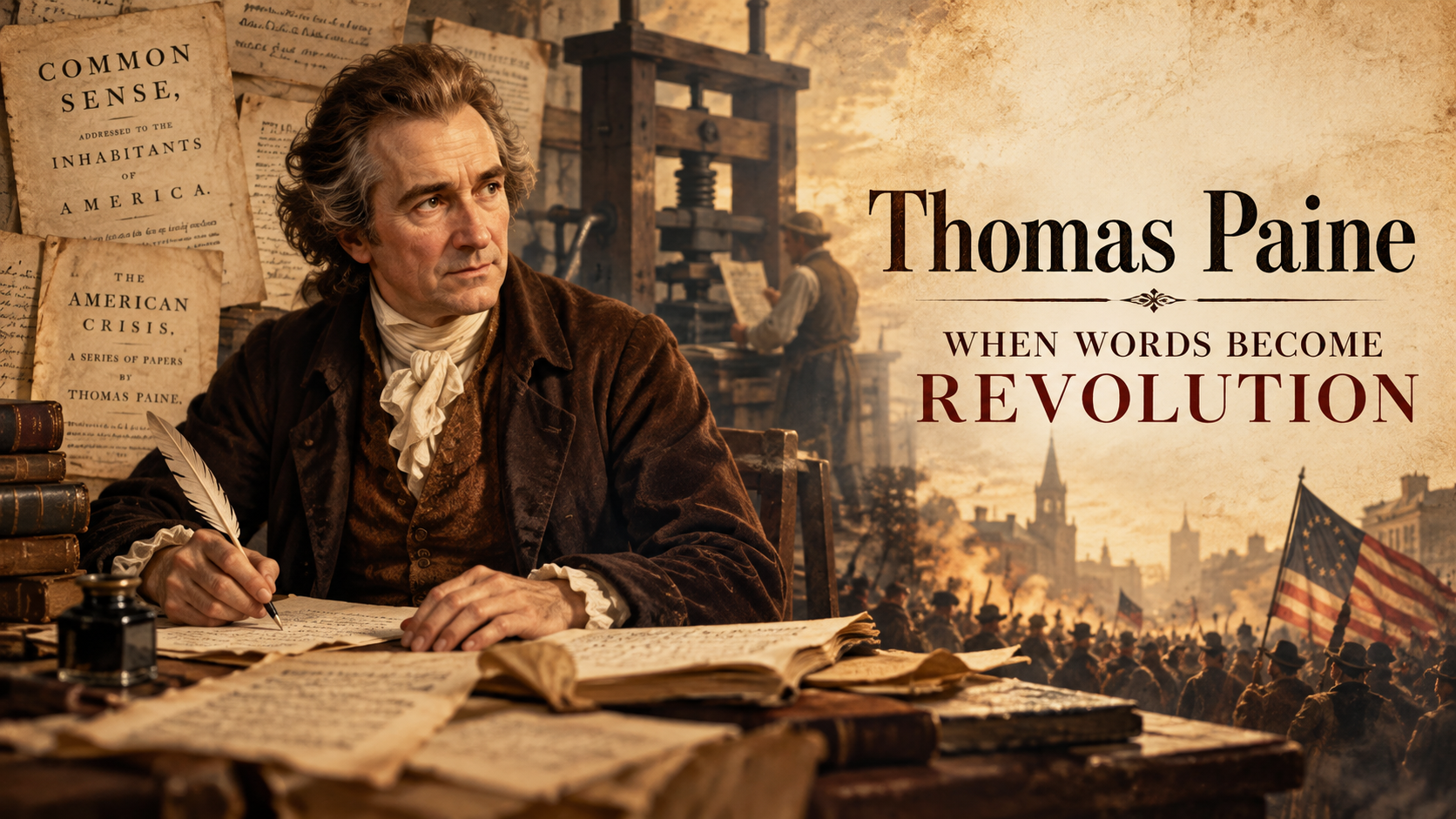
As I continue introducing the people whose lives and ideas inspired poems in my upcoming collection, Inspired Poetry: Justice, Freedom & Human Rights, I come to someone whose greatest instrument was neither a sword nor political office.
It was a pen.
Thomas Paine understood that before people could change their government, they first had to imagine that another kind of government was possible.
And he had an extraordinary ability to put revolutionary ideas into ordinary language.
Born in Thetford, England, in 1737, Paine arrived in Philadelphia in late 1774, only months before armed conflict between Britain and its American colonies began. ([Library of Congress Tile
Less than two years later, his words would become part of the intellectual fire of the American Revolution.
Common Sense
In January 1776, Paine published Common Sense.
Its argument was audacious.
The colonies should not merely protest British policies.
They should become independent.
Paine attacked hereditary monarchy and challenged the assumption that kings possessed some natural or inherited right to rule other human beings. Common Sense instead argued for representative government and an American break from the British Crown. (Library of Congress)
But just as important as what Paine argued was how he argued it.
He wrote for ordinary people.
Political philosophy was often expressed in the language of educated elites. Paine stripped much of that away. His prose was direct, forceful, and understandable to readers who might never have considered themselves philosophers.
That may be one of his greatest lessons for writers.
Ideas do not become powerful because they are complicated.
Sometimes they become powerful because someone finally makes them clear.
“These Are the Times That Try Men’s Souls”
Independence was declared in July 1776.
Winning it was another matter.
By the end of that year, the American cause was struggling militarily. Paine again turned to writing.
His first American Crisis essay appeared in December 1776 and opened with words that have survived for more than two centuries:
“These are the times that try men’s souls.”
Paine distinguished between those who supported liberty when doing so was easy and those willing to remain committed when the outcome was uncertain and the cost was real.
The Crisis essays were written throughout the Revolutionary War to encourage Americans to continue the struggle. (Library of Congress)
It is a distinction that reaches well beyond war.
Principles are easiest to claim when they require nothing from us.
Their meaning often becomes apparent when keeping them becomes difficult.
Rights Do Not Belong to Kings
Paine’s thinking did not end with American independence.
He returned to Europe and eventually became deeply involved in debates surrounding the French Revolution.
In Rights of Man, published beginning in 1791, Paine defended the principles of political revolution and challenged hereditary monarchy and aristocratic privilege. His broader argument was that political authority ultimately derives from people—not from bloodlines, titles, or inherited social position. (Library of Congress)
That belief placed him in conflict with the British government and made him a celebrated and controversial figure on both sides of the Atlantic.
Paine was not defending one country’s exclusive claim to liberty.
Increasingly, he was arguing for something larger:
human rights themselves.
Revolution Did Not Mean Revenge
One part of Paine’s story especially interests me because it demonstrates how difficult it can be to remain faithful to principle when surrounded by anger.
Paine supported the French Revolution and was elected to France’s National Convention.
But when the revolutionaries decided the fate of King Louis XVI, Paine opposed executing him.
He argued instead for imprisonment followed by exile.
Paine had spent years attacking monarchy. Yet opposing monarchy did not require him to demand the death of the monarch. His recorded proposal called for Louis and his family ultimately to be banished rather than executed. (Library of Congress)
That distinction matters.
It is possible to oppose a system without surrendering one’s humanity toward the people within it.
Revolution can seek justice without becoming vengeance.
The Right to Think Freely
Later in life, Paine entered an even more dangerous debate.
Religion.
In The Age of Reason, Paine criticized organized religion and argued for religious belief grounded in reason and individual conscience.
He was a deist rather than an atheist, but his criticism of institutional religion damaged his reputation profoundly, particularly in the United States. The National Archives notes that his religious views contributed significantly to the decline of his public standing. (National Archives)
Yet buried within that controversy was another principle Paine considered fundamental:
the right of another person to hold an opinion different from his own.
For a man who spent his life challenging authority, freedom of conscience was another form of human liberty.
A Revolution Larger Than Independence
Thomas Paine is often remembered primarily for Common Sense.
But his body of work was much broader: The American Crisis, Rights of Man, The Age of Reason, Agrarian Justice, and numerous political essays and letters. The Library of Congress preserves collections encompassing these major writings. (Library of Congress)
Taken together, they reveal someone repeatedly asking variations of the same question:
By what right does one human being claim power over another?
A king over a citizen.
An aristocracy over ordinary people.
One generation over generations yet unborn.
An institution over individual conscience.
Paine did not provide perfect answers to every question, nor should any historical figure be transformed into one.
But he possessed a quality I find especially important for this collection.
He questioned things people had been taught not to question.
The Courage of an Idea
Revolutions are usually remembered through battles, declarations, flags, and famous leaders.
But before many revolutions can occur in the world, another revolution has to occur inside the human mind.
Someone must first say:
It does not have to remain this way.
That was Thomas Paine’s particular gift.
He took ideas about liberty, government, equality, and human dignity and placed them into words ordinary people could carry with them.
Words that could be printed.
Shared.
Debated.
Rejected.
Defended.
And sometimes acted upon.
Perhaps that is why a writer who lived more than two centuries ago still belongs in a collection about justice, freedom, and human rights.
Because Paine demonstrated something writers continue to discover:
A pen cannot force people to change the world.
But sometimes it can help them imagine that the world can be changed.
Thomas Paine is one of the historical figures inspiring a poem in my forthcoming collection, Inspired Poetry: Justice, Freedom & Human Rights. Through these poems and the stories behind them, I am exploring people who challenged inherited assumptions, confronted injustice, and expanded the conversation about what human freedom might mean.