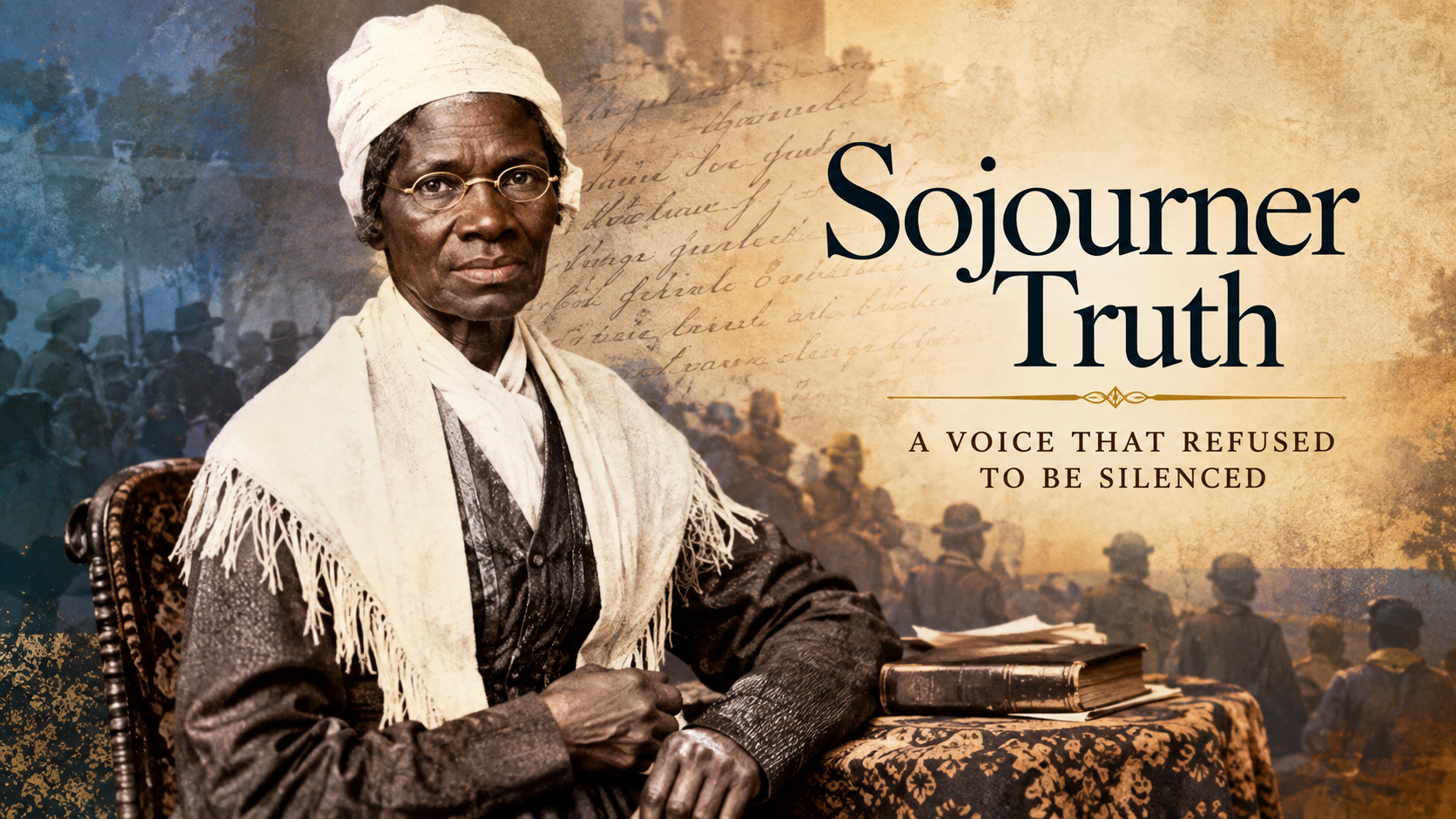
As I continue introducing the people whose lives inspired poems in my upcoming collection, Inspired Poetry: Justice, Freedom & Human Rights, I come to a woman who quite literally chose a name that described her purpose.
Sojourner Truth.
She was born Isabella Baumfree around 1797 in Ulster County, New York—not free, but enslaved.
Her earliest years were shaped by something difficult to reconcile with the ideals Americans were already proclaiming about liberty and human equality: she was bought and sold as property.
As a child, Isabella was separated from members of her family. She was sold at auction and passed among enslavers. She endured violence and deprivation, married an enslaved man named Thomas, and became a mother.
Then, in 1826, she took her infant daughter Sophia and walked away.
New York was moving toward the final abolition of slavery within the state, scheduled for 1827, but Isabella’s enslaver had reportedly reneged on a promise to free her early. Rather than continue waiting for someone else to grant her freedom, she left.
Her struggle did not end there.
Her young son Peter had been illegally sold away from New York and sent to Alabama. Isabella went to court to fight for his return.
And she won.
An enslaved Black woman—without wealth, political power, or formal education—successfully used the legal system to challenge a white man and recover her son.
That fact alone deserves to be remembered.
But Isabella Baumfree’s story was only beginning.
Becoming Sojourner Truth
In 1843, she experienced a profound spiritual calling and changed her name.
She would be Sojourner, because she would travel.
She would be Truth, because truth was what she intended to speak.
And speak she did.
Truth became an abolitionist, preacher, and advocate for women’s rights. She traveled throughout the country speaking before audiences at a time when public authority was overwhelmingly reserved for white men.
She could not read or write, yet people came to hear her words.
Her authority came from somewhere else—from experience.
She knew what slavery meant because she had lived it.
She knew what it meant for families to be torn apart because hers had been.
She understood the vulnerability of women because she had experienced both racial and sexual inequality.
And she understood faith not as an excuse to tolerate injustice, but as a reason to confront it.
“Ain’t I a Woman?”
Perhaps no words are more closely associated with Sojourner Truth than:
“Ain’t I a Woman?”
There is an important complication to that famous phrase.
Truth delivered her celebrated women’s-rights speech in Akron, Ohio, in 1851, but the familiar version containing the repeated phrase “Ain’t I a Woman?” was published years later by abolitionist Frances Dana Barker Gage.
An earlier account of the speech, published shortly after Truth delivered it, does not contain that refrain and represents her speech differently.
That distinction matters.
Sojourner Truth was born and raised in New York and spoke Dutch as her first language. The Southern dialect later attributed to her almost certainly was not how she actually spoke.
The legend should not obscure the woman.
Because her actual argument was powerful enough.
Truth confronted a society in which the movements for abolition and women’s rights sometimes struggled with their own prejudices and exclusions. She challenged the notion that women were inherently weak while simultaneously forcing listeners to recognize that society did not extend the supposed protections of womanhood equally to Black women.
Her very existence challenged the categories people used to justify inequality.
Freedom Was Not the End of the Work
The abolition of slavery did not cause Sojourner Truth to stop advocating for justice.
During the Civil War, she supported Black Union soldiers and assisted formerly enslaved people. She met President Abraham Lincoln in 1864.
After the war, she continued fighting.
She advocated for voting rights.
She worked to improve opportunities for freed people.
She challenged segregation.
She even campaigned for the federal government to provide land in the West to formerly enslaved people so that emancipation might be accompanied by genuine economic independence.
That proposal never became the national policy she sought.
But the idea reveals something important about her understanding of freedom.
Freedom was not simply the absence of chains.
Freedom required the ability to build a life.
The Courage to Speak
What draws me to Sojourner Truth is not merely that she possessed strong convictions.
History is filled with people who believed strongly in something.
What distinguishes people like Truth is the willingness to speak when speaking carries a cost.
She had almost none of the advantages normally associated with influence.
She had been enslaved.
She was Black.
She was a woman.
She lacked formal education.
She lived in a nation that frequently treated each of those characteristics as justification for denying someone authority.
And still she stood before audiences and spoke.
Perhaps that is one of the lessons worth carrying forward from her life.
Truth does not require permission from power before it can be spoken.
Sometimes history moves because someone who was expected to remain silent decides that silence is no longer acceptable.
Sojourner Truth spent much of her life doing exactly that.
And nearly two centuries later, we are still listening.
Sojourner Truth is one of the historical figures inspiring a poem in my forthcoming collection, Inspired Poetry: Justice, Freedom & Human Rights. Through these poems and the stories behind them, I hope to explore the people who challenged injustice, expanded our understanding of human dignity, and reminded us that rights rarely advance without someone first having the courage to demand them.