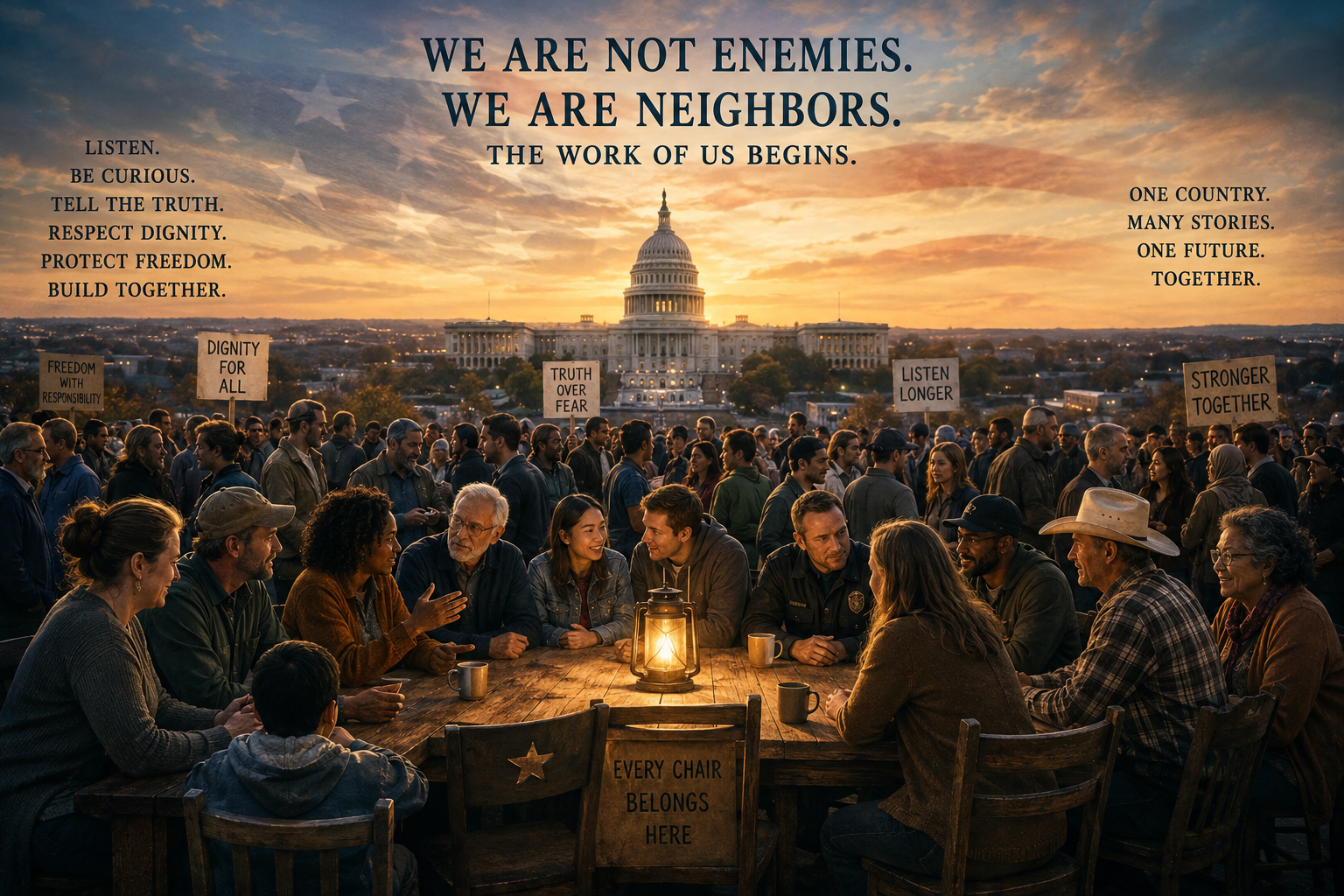
Presidential Election Night — 2028
My fellow Americans—
Tonight, you have done something remarkable.
You have elected a President who did not ask you to become a Republican.
Who did not ask you to become a Democrat.
Who did not ask you to abandon your beliefs, your faith, your traditions, your doubts, your anger, or your hopes in order to belong here.
You simply asked for something different.
And tonight, together, we proved that different is still possible.
I stand before you grateful beyond words. But I also stand here humbled by something much larger than an election.
Because this victory does not belong to me.
It belongs to the millions of Americans who decided that our disagreements do not have to become hatred.
It belongs to people who became tired of being told that their neighbor was their enemy.
It belongs to Republicans who voted for me.
Democrats who voted for me.
Independents who voted for me.
And it belongs just as surely to those who did not vote for me.
If you voted against me tonight, hear this clearly:
I will be your President too.
You do not owe me your loyalty.
You do not owe me your agreement.
In this country, you are free to criticize me, challenge me, organize against me, protest my decisions, and vote me out of office.
That is not disloyalty.
That is democracy.
And as President, I will defend your right to do it.
For too long, American politics has been built around a dangerous question:
Which side are you on?
I believe there is a better question.
What can we build together?
Because before we are conservatives or liberals, rural or urban, religious or secular, wealthy or struggling, native-born or newly arrived—
we are human beings sharing a country.
Every person is a person before they are a position.
And somewhere along the way, we forgot that.
We built industries around our anger.
Algorithms learned that outrage could hold our attention longer than understanding.
Politicians discovered that fear could raise money.
Television discovered that conflict could raise ratings.
Social media discovered that our divisions could be monetized.
And gradually, Americans who had never met one another were taught to fear one another.
Tonight, I am asking us to stop.
Not to stop disagreeing.
Never that.
A free people will disagree.
We should disagree.
Democracy is not the absence of disagreement.
Democracy is the extraordinary idea that people who profoundly disagree can still share a nation without trying to destroy one another.
That requires something from all of us.
It requires listening.
It requires humility.
It requires the courage to occasionally say three words that have become strangely difficult in public life:
I was wrong.
And sometimes four more:
Tell me what you see.
Our country faces enormous challenges.
Families work hard and still wonder whether they can afford a home.
Parents worry whether their children will inherit greater opportunity or greater debt.
Workers wonder whether artificial intelligence will improve their lives or replace their livelihoods.
Young people are connected to nearly everyone and sometimes feel known by almost no one.
Our climate is changing.
Our infrastructure is aging.
Our national debt continues to grow.
Technology is advancing faster than our laws and institutions can understand it.
We possess tools capable of connecting humanity—and tools capable of deceiving humanity on a scale previous generations could scarcely imagine.
And around the world, authoritarianism again whispers an ancient temptation:
that freedom is too difficult.
That democracy is too messy.
That people cannot govern themselves.
I reject that.
I believe in democracy not because democracy is efficient.
It often isn’t.
I believe in democracy because human beings should never surrender their conscience to another human being.
Government belongs to the governed.
Power is borrowed.
The Constitution is not an inconvenience to be overcome by presidents.
It is the boundary presidents swear to respect.
And beginning in January, that principle will govern this administration.
The Department of Justice will not be my weapon.
The military will not be my political instrument.
The intelligence services will not be used to punish critics.
The press will not be treated as an enemy because it asks uncomfortable questions.
And political opponents will not become enemies of the state because they oppose the President.
The presidency is powerful enough.
It does not need to become more powerful.
In fact, one of the responsibilities of anyone entrusted with power should be knowing when not to use it.
We will also confront something that has quietly wounded this country.
Corruption does not always arrive carrying a suitcase of cash.
Sometimes it arrives legally.
It arrives through access.
Influence.
Lobbyists writing legislation.
Campaign money purchasing attention ordinary citizens cannot afford.
Public servants leaving government to profit from decisions they helped make.
And industries becoming so intertwined with government that Americans can no longer tell where public service ends and private interest begins.
We will change that.
Not because business is the enemy.
Not because wealth is immoral.
But because in a republic, citizenship cannot have a premium membership.
No American should need a lobbyist to be heard by their own government.
And no corporation should possess more political voice simply because it possesses more money.
But government cannot repair America by itself.
Washington cannot legislate friendship.
Congress cannot appropriate compassion.
A President cannot sign an executive order making Americans trust one another again.
That work belongs to us.
It happens at kitchen tables.
In classrooms.
In churches, synagogues, mosques, temples, and community centers.
In union halls and boardrooms.
At diners and barber shops.
On farms.
At Little League games.
On factory floors.
At neighborhood meetings.
And sometimes between two strangers who simply decide to sit down together.
We need more tables in America.
And fewer walls.
Tables where people do not arrive to win.
Tables where nobody has to surrender their convictions.
Tables where curiosity becomes more important than accusation.
Tables where an empty chair reminds us that someone whose voice is missing still belongs in the conversation.
Imagine what might happen if Americans began doing that again.
Imagine a conservative farmer in Iowa sitting beside a climate activist from Seattle.
A police officer beside someone who marched for police reform.
A pastor beside an atheist.
A gun owner beside a mother who lost a child to gun violence.
An immigrant beside someone deeply worried about the border.
Not to stage a debate.
Not to produce a viral video.
Not to humiliate one another.
Simply to ask:
What are you afraid of?
What do you hope for?
What happened in your life that brought you to where you stand today?
Those conversations will not magically solve our disagreements.
But they may accomplish something democracy desperately needs.
They may allow us to see one another again.
And that is where I believe the renewal of this country begins.
Not with me.
With us.
I will make mistakes as your President.
When I do, I will tell you.
There will be policies proposed by this administration that Congress rejects.
There will be decisions you disagree with.
There will be moments when progress seems painfully slow.
That is the nature of self-government.
But I promise you this:
I will never ask you to worship your government.
I will ask you to participate in it.
I will never tell you that I alone can fix America.
No President can.
I will never tell you that our problems are caused by one race, one religion, one generation, one political party, immigrants, conservatives, liberals, rural Americans, or people living in cities.
America has never been that simple.
And anyone telling you otherwise is selling you something.
Tonight, I ask something harder of you.
Stay curious.
Listen longer.
Question what confirms your prejudices as carefully as you question what challenges them.
Protect the dignity of people with whom you disagree.
Teach our children that strength does not require cruelty.
Remember that compromise is not surrender when free people are governing together.
And when someone tries to convince you that another American is your enemy simply because of how they voted—
refuse.
Our children are watching us.
And one day they will ask what we did during this strange and difficult period in the American story.
I hope we can tell them:
We did not surrender to cynicism.
We did not allow technology to make us less human.
We did not trade liberty for the comfort of certainty.
We did not confuse cruelty with strength.
We did not allow disagreement to become hatred.
We remembered something.
Something simple.
Something ancient.
Something profoundly American.
That freedom carries responsibility.
That power requires restraint.
That truth matters.
That every human being possesses dignity.
And that democracy ultimately depends not upon presidents—
but upon people.
Tonight, there are Americans celebrating.
There are Americans disappointed.
There are Americans frightened about what comes next.
To all of you, I say:
There is room at this table.
Your chair is still here.
Bring your convictions.
Bring your questions.
Bring your anger if you must.
But bring your humanity too.
Because tomorrow morning, when the signs come down and the advertisements stop and the election maps disappear from our television screens, we will wake up to the same neighbors.
The same communities.
The same country.
And the same unfinished experiment handed to us by generations before us.
We have inherited that experiment.
For a little while, it is ours to protect.
And someday, we will hand it to our children.
May we give them a nation a little kinder than the one we inherited.
A little wiser.
A little freer.
A little more just.
And perhaps, finally, a little less afraid of itself.
The election is over.
The work of us begins.
Thank you.
God bless you.
And may we be worthy of one another.