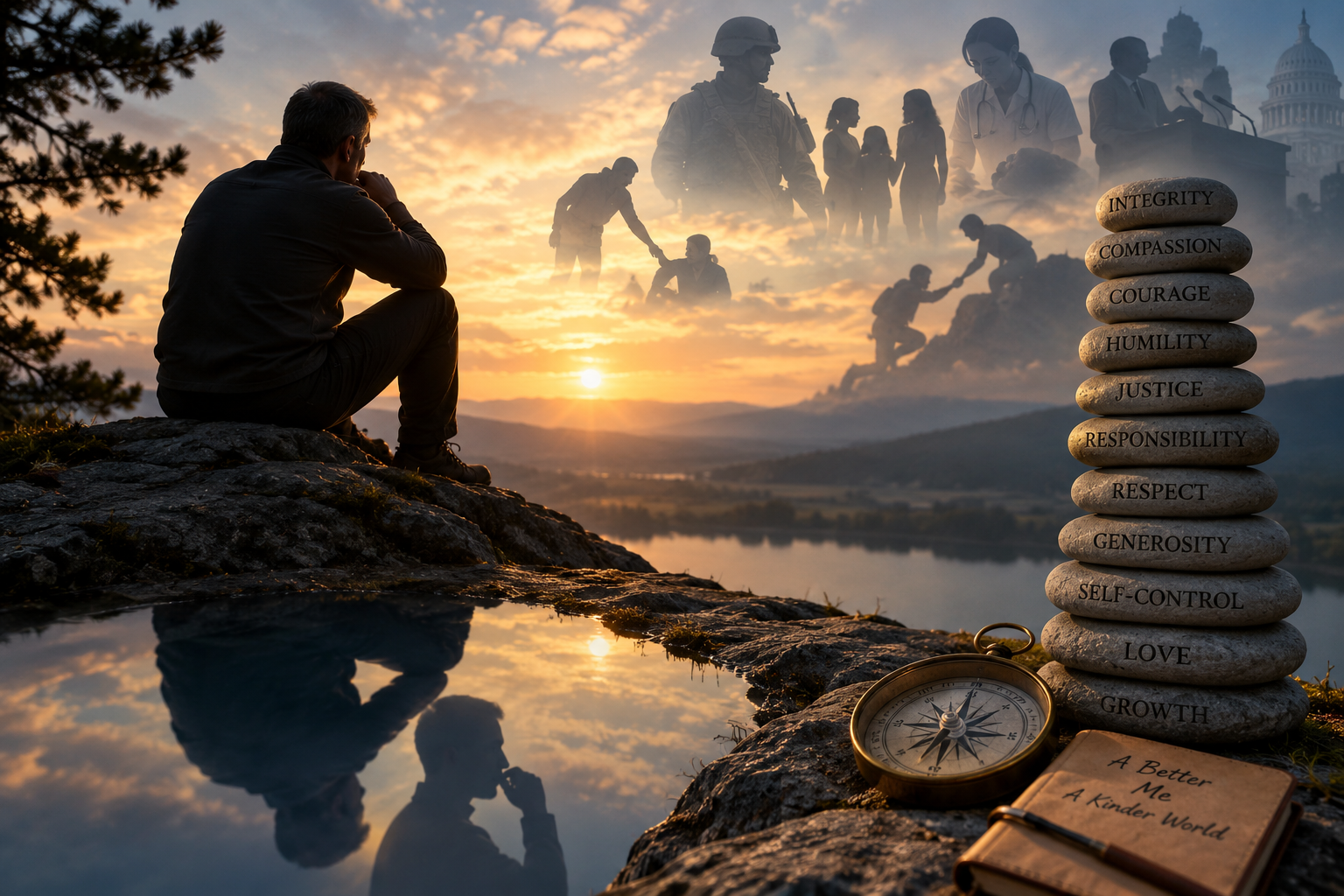
I have noticed something about myself.
I am almost constantly measuring.
Not consciously, perhaps, and certainly not with a checklist in my hand. But somewhere beneath my observations of people, their words, their choices and their behavior, I seem to be asking a question:
Is this a good human being?
And inevitably, another question follows:
Am I?
I recognize that I tend to apply this measure more critically to men, and perhaps most critically to people who possess positions of power, authority or influence.
I’ve wondered why.
The answer seems to be that my understanding of goodness was assembled over a lifetime.
Some of it came from my family and the values instilled in me by my parents.
Some came from teachers, mentors and people I admired.
Some came from philosophy and spirituality—from humanity’s centuries-long effort to understand what it means to live a worthy life.
Some even came from fictional characters who demonstrated courage, sacrifice, loyalty or compassion in stories that remained with me long after I finished reading them.
Some came from military service, where words like duty, honor, courage, leadership and responsibility carried consequences beyond abstraction.
And some came from healthcare, where I witnessed human beings at extraordinarily vulnerable moments and learned something about the enormous significance of simply showing up for another person with competence, compassion and dignity.
Taken together, those experiences formed an internal compass I don’t remember consciously constructing.
Yet I carry it.
And when I consider the qualities I use to measure goodness, I find that they are hardly unique to me.
Across philosophy, spiritual and religious traditions, psychology, literature and ordinary human experience, remarkably similar qualities appear again and again:
Integrity. Compassion. Courage. Responsibility. Humility. Justice. Self-control. Honesty. Reliability. Respect. Generosity. The capacity to love. And the willingness to continue growing.
Perhaps that convergence tells us something.
A good human being is not necessarily the strongest person in the room.
Not the wealthiest.
Not the most successful.
Not the most educated.
Not the most admired.
Not the loudest.
And certainly not someone who never makes mistakes.
Perhaps goodness is found instead in the person who keeps trying to choose what is right—especially when choosing what is right costs something.
Integrity asks whether our behavior matches the principles we claim to hold.
Compassion asks whether another person’s suffering matters to us.
Courage asks what we will do when doing the right thing frightens us.
Responsibility asks whether we will carry what belongs to us rather than finding someone else to blame.
Humility asks whether we can entertain the possibility that we are wrong.
Justice asks whether we extend fairness beyond those who look, believe, vote, worship or live as we do.
Self-control asks whether possessing the ability to do something means we necessarily should.
Honesty asks us to tell the truth while remembering that truth stripped of compassion can become another instrument of cruelty.
Respect asks whether we can recognize another person’s dignity even when that person can offer us nothing.
Generosity asks what we are willing to give without applause.
Love asks whether we are strong enough to be tender.
And growth asks whether we are willing to become tomorrow what we failed to be today.
But there is one measure I find myself returning to more than almost any other:
What does a person do with power?
Power reveals things.
When someone has authority, wealth, physical strength, influence, status, knowledge or simply an advantage over another human being, choices become possible that were not possible before.
They can dominate.
Or empower.
Humiliate.
Or preserve dignity.
Exploit.
Or protect.
Demand obedience.
Or invite participation.
Seek revenge.
Or exercise restraint.
Perhaps this is why I find myself more demanding of people who possess power.
The greater our ability to affect the lives of others, the greater, I believe, our responsibility for how that ability is used.
But there is a danger hiding inside this meditation.
Judgment.
Because once I establish my criteria for a good human being, it becomes very easy to hold that ruler against everyone else.
And perhaps goodness requires something more difficult.
Turning the ruler around.
If I expect humility from another person, am I humble?
If I demand honesty from leaders, am I honest when honesty costs me something?
If I condemn cruelty, what do I do with my own anger?
If I expect people to reconsider beliefs when presented with better evidence, can I reconsider mine?
If I believe powerful people should admit mistakes, how readily do I say, I was wrong?
If I expect compassion toward people I care about, can I extend compassion toward someone I don’t understand—or even someone I dislike?
If I believe every human being possesses dignity, do I preserve the dignity of people whose behavior I condemn?
That may be the hardest test of all.
Because perhaps the question “Is that person a good human being?” can never be answered completely from the outside.
We see moments.
We see choices.
We see failures.
We see acts of courage and acts of selfishness.
But we rarely see the entirety of another person’s struggle.
And so perhaps discernment is necessary while judgment requires humility.
We should evaluate behavior.
We should hold people accountable.
We should expect more from those entrusted with power.
We should speak against cruelty, dishonesty, injustice and abuse.
But we should also remember that the standard we hold before the world belongs before us as well.
Maybe being a good human being isn’t a status anyone finally earns.
Maybe there is no certificate.
No finish line.
No moment when we can confidently announce:
I have arrived. I am good.
Perhaps goodness is a practice.
A thousand ordinary decisions made over a lifetime.
Sometimes we succeed.
Sometimes we fail.
Sometimes we recognize our failure immediately.
Sometimes it takes years.
And then tomorrow gives us another opportunity.
So perhaps instead of asking only,
“Am I a good human being?”
I might ask something more useful:
“Was I a good human being today?”
Did I leave someone with more dignity rather than less?
Did I reduce suffering where I could?
Did I listen?
Did I tell the truth?
Did I use whatever power I possessed responsibly?
Did I have the courage to stand when standing was required?
Did I have the humility to yield when I was wrong?
Did I love?
Did I grow?
And when the answer to one of those questions is no—
perhaps there is one final question:
What will I choose tomorrow?
That, increasingly, is where I think goodness lives.
Not in perfection.
Not in judgment.
Not even in certainty.
But in the persistent, imperfect, lifelong effort to become a little more worthy of the human being we hope ourselves to be.
A Closing Meditation
May I have the courage to examine others without forgetting to examine myself.
May I recognize wrongdoing without surrendering compassion.
May I expect much from those entrusted with power—and even more from myself when power is placed in my hands.
May I remember that strength without kindness is diminished, conviction without humility is dangerous, and truth without compassion can wound.
May I preserve the dignity of others without abandoning my principles.
May I admit when I am wrong.
May I repair what I can.
May I keep learning.
May I keep growing.
And when I wonder whether I am a good human being, may I remember that the answer is not something I declared yesterday.
It is something I am choosing today.