Why I decided to imagine something harder: a believable path toward hope.
I already have enough to write.
Deep Below, the first novel in a planned series, is moving through the pipeline toward completion. So is the next book in my Inspired Poetry series, Justice, Freedom & Human Rights.
A sensible person might look at those projects and say, Perhaps you should finish what you already started.
Apparently, my imagination did not receive that memo.
New ideas have a habit of arriving whether invited or not. Some disappear almost as quickly as they come. Others sit down, make themselves comfortable, and refuse to leave.
Recently, one of those ideas was for a dystopian political thriller.
And I liked it.
There was plenty to work with: political division, fear, manipulation, technology, concentrated power, propaganda, institutional failure, tribalism, distrust—the ingredients are certainly available.
Maybe a little too available.
Because somewhere in thinking about the story, I stopped.
I found myself asking a surprisingly simple question:
Do I—or do we—really need another dystopian story when, for many people, reality already feels dystopian enough?
That doesn’t mean dystopian literature isn’t valuable. Quite the opposite.
Some of our most important novels have imagined terrible futures precisely so we might recognize the paths leading toward them. Stories can function as warnings. They can hold up mirrors. They can exaggerate tendencies already present in society until we finally see what has been sitting in front of us all along.
There will always be value in asking:
What happens if we continue down this road?
But another question began bothering me more.
What happens if we don’t?
What if people recognize the road they’re traveling and begin changing direction?
Not all at once.
Not because humanity suddenly becomes enlightened.
Not because everyone begins agreeing with everyone else.
And certainly not because some heroic leader appears and fixes everything.
What if change happens the way meaningful human change usually happens—unevenly, imperfectly, locally and person by person?
That question interested me far more.
And from it, a different novel began taking shape.
Its working title is The Wave.
Not Utopia. Something More Difficult.
I don’t want to write a utopian story.
Human beings are far too complicated for that.
We are capable of extraordinary compassion and astonishing cruelty. We cooperate and compete. We love deeply and sometimes fear irrationally. We form communities and tribes. We protect one another, exclude one another, forgive one another and occasionally hurt one another terribly.
Any believable story about a better human future has to begin there.
So The Wave isn’t about humanity somehow becoming perfect.
It’s about humanity remaining human.
The more interesting question, at least to me, is whether imperfect people can create better systems, healthier communities and a more humane civilization without first becoming perfect themselves.
Can people disagree without becoming enemies?
Can political identity stop determining how we see another person’s humanity?
Can institutions reward cooperation rather than outrage?
Can technology strengthen human connection rather than continually exploit our divisions?
Can communities rediscover the idea that caring for one’s neighbor isn’t ideological?
Can enough small choices accumulate into something larger?
And perhaps most importantly:
Can change spread?
That became the central idea behind The Wave.
Not a revolution imposed from above.
Not a movement requiring everyone to believe the same things.
Something quieter.
One person behaves differently.
Someone notices.
A conversation changes.
A relationship changes.
A neighborhood changes.
An institution responds.
Another community experiments.
Something that worked in one place appears somewhere else.
Then somewhere else.
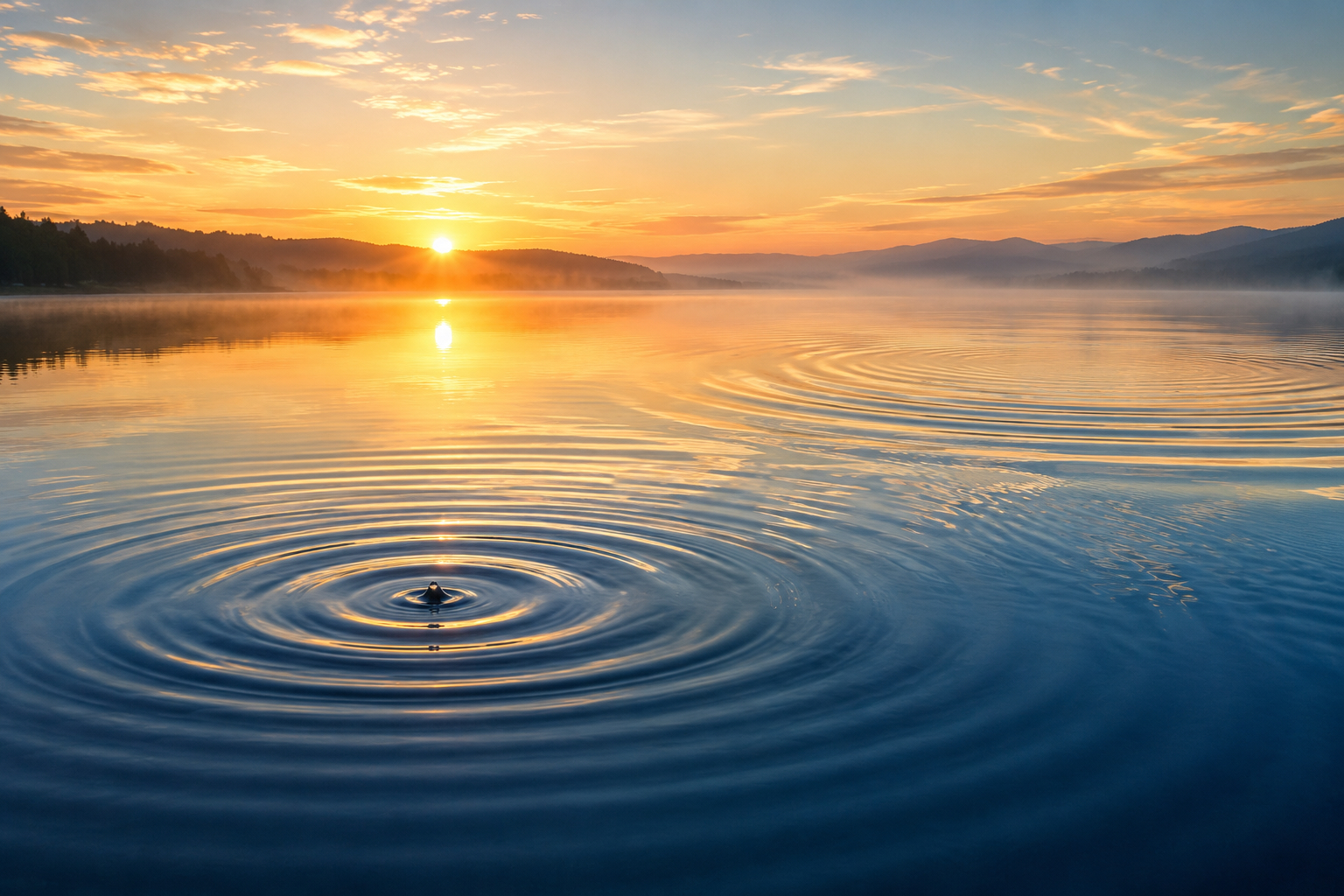
A ripple becomes another ripple.
Until eventually someone realizes they aren’t looking at isolated ripples anymore.
They’re looking at a wave.
Then Something Unexpected Happened
While thinking about this story, I realized I wasn’t only deciding what kind of novel I wanted to write.
I was beginning to understand something about what kind of author I want to become.
Without intending to, I found myself forming something resembling a personal mission statement.
So, while it will undoubtedly continue evolving along with me, this is where I find myself today:
My Mission as a Writer
I want to write stories that take seriously the problems confronting humanity without surrendering to the assumption that our worst tendencies must determine our future.
I want to explore difficult questions without pretending there are easy answers.
I want to write about people before positions, humanity before ideology, and possibility without pretending that meaningful change is easy.
I don’t want to manufacture hope by ignoring reality.
I want to search for hope within reality.
I want to create characters who are complicated because human beings are complicated—people capable of being right about one thing and terribly wrong about another; people who carry wounds, contradictions, loyalties, fears, prejudices, courage and love.
I want to resist reducing people to heroes and villains when the more interesting territory often lies somewhere between them.
I want my stories to ask not only what might go wrong, but what might happen if ordinary human beings begin choosing—imperfectly, gradually and sometimes courageously—to make things better.
And perhaps most importantly, I want to remember something increasingly easy to forget:
Every person is a person before they are a position.
That doesn’t mean every idea deserves agreement.
It doesn’t mean harmful behavior should go unchallenged.
It doesn’t require abandoning conviction.
It simply means remembering that behind nearly every political label, religious identity, philosophy, nationality and worldview is another human being experiencing this strange and remarkable existence from a vantage point different from our own.
Maybe remembering that is not the solution to everything.
But perhaps it is a place to begin.
So I’m Curious…
The Wave is still very young.
There are characters I haven’t met yet.
Questions I haven’t answered.
Probably entire plotlines waiting somewhere in my subconscious to introduce themselves at inconvenient hours.
And I still have those other books to finish.
I haven’t forgotten. I promise.
But before this idea grows much further, I’m curious about something.
We have no shortage of stories warning us about the futures we should fear.
Are we still hungry primarily for stories that show us what might happen if everything goes wrong?
Or might we also be hungry for stories willing to attempt something different:
to imagine how things might realistically begin going right?
Not perfectly.
Not easily.
Not without conflict, setbacks or people behaving very much like people.
But enough.
Enough people making enough different choices that something begins moving through a family, a neighborhood, a community, a country…
perhaps eventually through the world.
A ripple.
Then another.
And maybe, if we’re fortunate,
a wave.